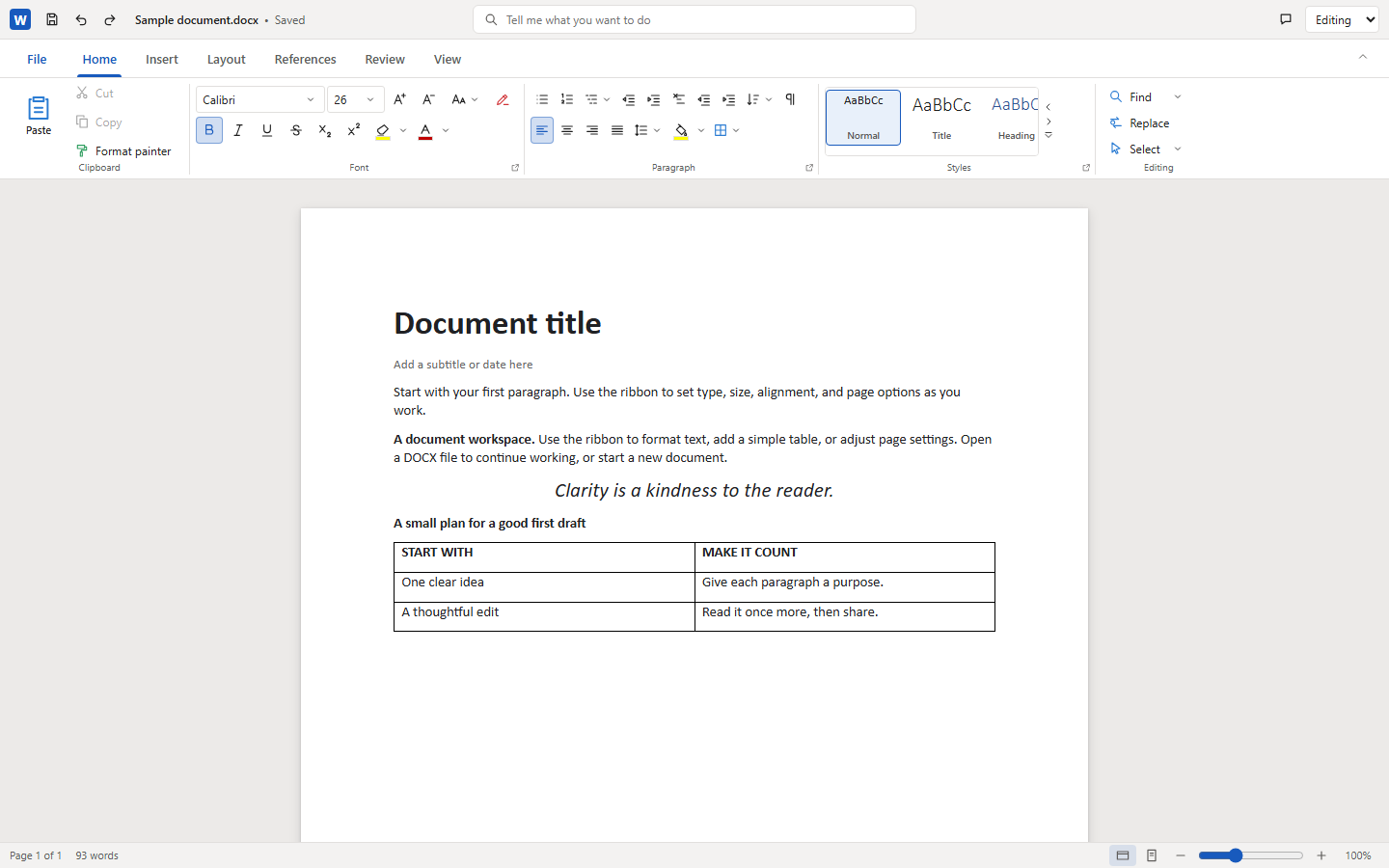
One shared editor
A Word-style ribbon, title bar, File backstage, and status bar live in one web component, with undo/redo, find and replace, zoom, and a read-only mode. Bindings add no UI of their own.
Architecture →Early implementation · Apache-2.0 · TypeScript
A browser Word editor for React, Vue, Angular, Svelte, Solid, and vanilla JavaScript. One document model and one ProseMirror-backed <docx-editor> web component do the work; the framework adapters only wire up lifecycle and events.
npm install docx-react-viewerPublished to npm. Each framework package is self-contained: it bundles the editor and brings docx-core with it.
Live demo
This is the real editor running in your browser: the demo app built from this repository for each framework adapter, embedded live. Open the sample document, or split the view to see two local peers share one document.
Features
A Word-style ribbon, title bar, File backstage, and status bar live in one web component, with undo/redo, find and replace, zoom, and a read-only mode. Bindings add no UI of their own.
Architecture →A paginated view with line breaking, widow/orphan and keep rules, columns, table row splitting, repeating headers, footnote placement, and printing. It is this editor’s own approximation, not Word’s pagination.
Support roadmap →Styles, numbered and bulleted lists, tables, sections and columns, headers and footers, footnotes, and fields including TOC. Inline text boxes, a header watermark, and page borders can be inserted.
Outstanding work →Track Changes mode, accept and reject, next and previous revision, and a comments pane with replies and resolve. Comments are written back to comments.xml.
Editing text →A no-op save returns the original bytes. Supported edits preserve package parts outside the model, and edits that would damage unsupported content are rejected instead of dropped.
Model and saving →Word 97-2003 files load through the shared ole2 codecs. Main-body text imports, and constrained edits to existing paragraphs save back as .doc. Formatting and structural changes are rejected.
Support roadmap →A transport-neutral protocol exchanges validated ProseMirror steps through an authority, with transient presence. Your application owns networking, identity, permissions, and storage.
Collaboration →The editor interface ships in English, French, German, Spanish, and Simplified Chinese through one locale option. It translates interface text only, never document content.
Bindings →Status
This is an early implementation. It is not Microsoft Word parity: pagination is approximate, many features are not rendered with Word fidelity, password-protected files are unsupported, and Export DOCX cannot recover content the model omits. The support roadmap and outstanding-work pages list the gaps in detail.
Support roadmap →import { loadDocument } from 'docx-vanilla-viewer';
// Any editor package bundles this loader; it detects DOCX or legacy DOC from the bytes.
const loaded = await loadDocument(bytes);
console.log(loaded.model.blocks.length);
// Returns bytes in the original format. An untouched
// document comes back byte-for-byte; unsafe edits reject.
const output = await loaded.save(loaded.model);Getting started
Every adapter mounts the same <docx-editor>. Pass a document model, listen for changes, and give the container a height.
import { useState } from 'react';
import { createDocument } from 'docx-core';
import { WordEditor } from 'docx-react-viewer';

export function Editor() {
  const [model, setModel] = useState(() => createDocument());
  return (
    <WordEditor
      documentModel={model}
      readOnly={false}
      onDocumentChange={setModel}
    />
  );
}To run the demos or work on the editor itself, clone the repository. Bun is required.
bun install
bun run demoFAQ
Yes. docx-core and one self-contained editor package per framework are on npm, for example npm install docx-react-viewer. Each package is versioned on its own. Release policy →
The repository is Apache-2.0 licensed.
No. Pagination is an approximation, many features are not rendered with Word fidelity, and Export DOCX creates a new document from supported visible content. Parity is tracked separately for import, layout, editing, export, preservation, and accessibility. Support roadmap →
Supported edits are written back into the original package, and unsafe edits reject instead of silently degrading it. That is a design goal checked by regression tests, not a claim of lossless export. Architecture →
React, Vue 3, Angular, Svelte 5, SolidJS, and plain JavaScript. They share one editor and model; each adapter only handles mounting, property updates, and event forwarding. Bindings →
The protocol is transport-neutral and ships an in-memory reference authority. Networking, authentication, persistence, and permissions are your application’s responsibility. Collaboration →
Yes, with limits. Main-body text imports and constrained edits to existing paragraphs save back as .doc; formatting and structural changes are rejected.
Unsupported today.
Get started
Read the architecture, pick your framework guide, and try the demo with a document of your own. Apache-2.0 licensed, strict TypeScript, and honest about the gaps.